Jumat, 08 Maret 2013

The Secret Poetic Life of Trees

Autumn in reds

I like trees because they seem more resigned to
the way they have to live than other things do.
- Willa Cather

This month's prompt was inspired by a series of programs about trees that I listened to on the BBC. They were created in response to the ash dieback disease that has hit trees in the UK. Roger McGough hosts Poetry Please and presented some tree poems, old and new by DH Lawrence, Philip Larkin, Thomas Hardy, WB Yeats, Gerard Manley Hopkins and others.

 "The Secret Power of Trees"  looks at Britain's woodlands that were planted for timber or hunting but are now also used to help the mentally ill and elderly people as part of what is known as "social forestry." The power comes with seeing woodlands as therapeutic and healing landscapes, and not just by new age types. He points out that in Japan, doctors take seriously the practice of "forest air bathing", and claim all kinds of health benefits from simply being in the woods. It's a different trend in the poetry of trees, since in much older poetry, forests were often seen as scary places, full of evil spirits and outlaws.

Thinking about trees, some poems come to mind immediately, like "Birches" by Robert Frost which ends with that glorious wish to be a swinger of birches.

I'd like to get away from earth awhile
And then come back to it and begin over.
May no fate willfully misunderstand me
And half grant what I wish and snatch me away
Not to return. Earth's the right place for love:
I don't know where it's likely to go better.
I'd like to go by climbing a birch tree,
And climb black branches up a snow-white trunk
Toward heaven, till the tree could bear no more,
But dipped its top and set me down again.
That would be good both going and coming back.
One could do worse than be a swinger of birches.
Moving amateur birch swinging into a profession, one segment from the radio program looks at a professional tree climber, James Aldred, who climbs one of Britain's tallest trees, a giant redwood affectionately called Goliath, and sleeps in its branches.

In our current season, I think of  "Winter Trees" by William Carlos Williams

All the complicated details
of the attiring and
the disattiring are completed!
A liquid moon
moves gently among
the long branches.
Thus having prepared their buds
against a sure winter
the wise trees
stand sleeping in the cold.

But the two poems I decided to focus on this month for our writing prompt are poems that feature women interacting directly with a tree.

Woman Waving to Trees by Dorothea Tanning

Not that anyone would
notice it at first.
I have taken to marveling
at the trees in our park.
One thing I can tell you:
they are beautiful
and they know it.
They are also tired,
hundreds of years
stuck in one spot—
beautiful paralytics.
When I am under them,
they feel my gaze,
watch me wave my foolish
hand, and envy the joy
of being a moving target.

Loungers on the benches
begin to notice.
One to another,
"Well, you see all kinds..."
Most of them sit looking
down at nothing as if there
was truly nothing else to
look at until there is
that woman waving up
to the branching boughs
of these old trees. Raise your
heads, pals, look high,
you may see more than
you ever thought possible,
up where something might
be waving back, to tell her
she has seen the marvelous.


Another woman who might be seen from a distance as - odd? - is looking up into a plum tree and addressing the tree, its fruit and a visiting bird.

Woman Looking Up Into A Plum Tree by Melanie McCabe

Strung with whistle bones, frail reeds fledged, a bird
can fly or fold in, tuck beneath the wing the skull's
little engine, that tiny grist, that whit of will.

This is the secret kept in the crook of the limbs:
what claims flight must first be hollowed, must
whittle to a straw grace. Desire, that heavy

marrow, will someday open, riddle with holes
for wind to clean. The wet plum will parch to its
stone pit, dwindle and lift its faint whiff of almond.

But she is rooted still, tang of riven earth on
the back of her tongue, a late seed considering
another rending, an improbable sprouting into

turning air, a farfetched bloom. If she lightens, it is
slowly. Above her, the bird unfolds, beats sky with
thoughtless wings. She does not yet envy its going.
This month's prompt is obviously to write a poem that focuses on someone interacting, perhaps addressing, a tree. Your woman (or Man Swinging From Birches or Man Sleeping in a Redwood) will also need to be specific in their tree choice. It's sad how many people can't even identify the trees on their own property or ones they pass every day.  Of course, in Jane Kenyon's tale of "Taking Down the Tree," the specificity is that the tree is a Christmas tree, which is an alternate and legitimate take on the prompt too.

Submission Deadline: March 3, 2013.
Kamis, 07 Maret 2013

Some Anti-Love Poems for Valentine's Day


In case today is not the Valentine's Day of movies and songs, here are some "Anti-Love Poems" about breakups, heartache, and unrequited love. The Poetry Foundation describes these as more “Screw Cupid” than “Be Mine.”

A few samples:

The Glass Essay” by Anne Carson

In the days and months after Law left
I felt as if the sky was torn off my life.
   
The Flurry” by Sharon Olds

I mutter, “I feel like a killer.” “I’mthe killer”—taking my wrist—he says,
holding it. 

Cuckoldom” by B.J. Ward

if you look
for alimony,
it follows
acrimony

Semele Recycled” by Carolyn Kizer

After you left me forever,
I was broken into pieces,
and all the pieces flung into the river.

The Breather” by Billy Collins

All that sweetness, the love and desire—
it’s just been me dialing myself
then following the ringing to another room

Time Does Not Bring Relief: You All Have Lied” by Edna St. Vincent Millay

There are a hundred places where I fear
To go,—so with his memory they brim. 

Sonnet [You jerk you didn’t call me up]” by Bernadette Mayer

I’m through with you bourgeois boys
All you ever do is go back to ancestral comforts


National Haiku Writing Month

This month is the third annual National Haiku Writing Month.  National Haiku Writing Month takes place every February—the shortest month for the shortest genre of poetry.

The logo on the event website is a “No 5-7-5” sign to emphasize that haiku in English does not need to be syllabic lines of 5, 7 and 5.

I came across a post by John J. Dunphy. He owns a used book store called Second Reading Alton, Illinois. He was looking into a copy of The Best American Poetry 1991.

There were some haiku in the collection. Well, poems called "haiku."  A group of haiku by David Trinidad really bothered him. They were haiku based on 1960s TCV comedies like The Beverly Hillbillies and Gilligan's Island. That sounds pretty lame but that's not what bothered him.

Each haiku is just declarative sentence that has been broken into that three-line, 5-7-5 false form. As Dunphy says, "Cramming a sentence into a 5-7-5 straitjacket does not a haiku make."

I'm with Dunphy. Here's a Trinidad sample:
“Island Girls”
Mary Ann dons one
of Ginger’s dresses, but it
falls flat on her chest.

Japanese haiku poets do use a 5-7-5 format, but it applies to sounds, not syllables. Unfortunately, our syllables do not match our sounds. (Dunphy says that many translators believe that about 12 English syllables approximate the duration of 17 sounds in Japanese language.)

Haiku also don't have titles.

And they do focus on certain themes - especially nature - and imagistic language.

Dunphy provides some haiku of his own as examples, and they are good ones.
ant
on a tree stump
scurrying across decades


spring
the Inuit village
closer to the sea

You should give haiku a try this month. The NaHaiWriMo site has writing prompts. They are also on Facebook, so like them. And if you write haiku, post it on Twitter with the hashtag #nahaiwrimo.


Write in Scotland with Peter Murphy


WRITE in SCOTLAND with PETER MURPHY
GET AWAY TO WRITE - SCOTLAND
August 8-15, 2013

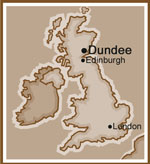
Using the vibrant university city of Dundee as our home base, join us for a week of writing, and exploring this beautiful country. We'll go beyond the typical tourist path and get to know the REAL Scotland. The retreat will feature supportive workshops, readings by local writers, and excursions to Edinburgh, castles, and more. Led by Peter Murphy.

Get away from the grind to write and be inspired. Using Dundee as your home base, you will spend a week writing, relaxing, and exploring this beautiful country, heading beyond the well-worn tourist path, and getting to know the real Scotland. Dundee, a university city of 150,000, bustles with Scottish arts and culture, set alongside a centuries-old seafaring community and 12th-century history.


LEARN MORE AND REGISTER TODAY


Tweeting Iambic Pentameter


Another piece of technology is mixing with poetry.

That hesitation right before a kiss
I don't remember ever learning this
I've never had a valentine before
I'm not a little baby anymore

If that is poetry, it's technological "found poetry."  Those rhyming couplets written in iambic pentameter come from Twitter and were found by an algorithm. Yes, those ten-syllable lines of alternating emphasis that we learned about in school when we studied Shakespeare, sonnets and blank verse have been pulled from tweets by a program called Pentametron.

Pentametron (@pentametron on twitter, which you can follow without joining twitter itself)  is set up to monitor public tweets, pull out those in iambic pentameter, look for pairs that rhyme, and then retweet them as a couplet.

The site's motto is:
"With algorithms subtle and discrete
I seek iambic writings to retweet."

Is it poetry? That's your call. But it is interesting that these random couplings sometimes produce logical groupings.

I haven't got the mindset anymore
the tiny inner voice becomes a Roar!
Another boy without a sharper knife.
Closed eye and hoping for a better life

This isn't the first poetry via Twitter site that I have written about. Earlier there was the "Longest Poem in the World" which is still running.

In an NPR interview, the creator of Pentamentron, Ranjit Bhatnagar, said that he had been "... inspired by the exquisite corpse games of the surrealists" and realized that Twitter could supply "an endless waterfall of tweets."

Some make sense -

I wanna be a news reporter, yo
I never listen to the radio

I pay attention to details okay.
Its gonna be a busy day today :(


and others are... well, not so clearly connected

She's like a rainbow, painted black and white.
Not going to the ball tomorrow night.

Of course, a lot of people who don't regularly read poetry might say that "real" poems often don't make sense to them, so...

Pentrametron generates 15 to 20 couplets of 140-characters or less on an average day.


Sabtu, 15 September 2012

100 Thousand Poets for Change Day 2012


September 29th is 100 Thousand Poets for Change Day 2012. 

You can join other poets around the USA and across the planet in a demonstration and celebration of poetry used to promote serious social, environmental, and political change.

100 Thousand Poets for Change will organize “participants” by local region, city, or state, and find individuals in each area who would like to organize their local event.

If you would like to organize an event in your community, visit http://www.100TPC.org to learn more and to see all the great events that took place last year.

If you are an organizer for your community this means that first you will consider a location for the event and begin to contact people in your area who want to participate in the event. Participation means contacting the media, posting the event on the web, in calendars, newspapers, etc., reading poems, performing in general, supplying cupcakes and beer (it’s up to you), demonstrating, putting up an information table, inviting guest speakers, musicians, etc., organizing an art exhibit, and documenting the event (this is important, too), and cleaning up, of course.

Each local organization determines what it wants to focus on, something broad like, peace, sustainability, justice, equality, or more specific causes like Health Care, or Freedom of Speech, or local environmental or social concerns that need attention in your particular area right now, etc.

On YouTube  http://www.youtube.com/user/100TPC

On Facebook  https://www.facebook.com/events/189035231173286/

Blog http://100tpcmedia.org/100TPC2012/

Sabtu, 01 September 2012

Wild Nights to End the Summer

Here's wishing you a few wild nights at this unofficial end of summer.

Wild nights - Wild nights! (269)
By Emily Dickinson


Wild nights - Wild nights!
Were I with thee
Wild nights should be
Our luxury!

Futile - the winds -
To a Heart in port -
Done with the Compass -
Done with the Chart!

Rowing in Eden -
Ah - the Sea!
Might I but moor - tonight -
In thee!


In an explication of the poem, Lilia Melani says: 
"Wild nights! Wild nights!" is a poem of unrestrained sexual passion and rapture. When the 1891 edition of Dickinson's poems was being prepared, Colonel Higginson wrote to his co-editor Mrs. Todd,
One poem only I dread a little to print--that wonderful 'Wild Nights,'--lest the malignant read into it more than that virgin recluse ever dreamed of putting there. Has Miss Lavinia [Emily Dickinson's sister] any shrinking about it? You will understand & pardon my solicitude. Yet what a loss to omit it! Indeed it is not to be omitted.
His comments reflect both the sexual narrowness of his times and the Myth of Emily Dickinson, Virgin Recluse.