Here's wishing you a few wild nights at this unofficial end of summer.
Wild nights - Wild nights! (269)
By Emily Dickinson
"Wild nights! Wild nights!" is a poem of unrestrained sexual passion and rapture. When the 1891 edition of Dickinson's poems was being prepared, Colonel Higginson wrote to his co-editor Mrs. Todd,One poem only I dread a little to print--that wonderful 'Wild Nights,'--lest the malignant read into it more than that virgin recluse ever dreamed of putting there. Has Miss Lavinia [Emily Dickinson's sister] any shrinking about it? You will understand & pardon my solicitude. Yet what a loss to omit it! Indeed it is not to be omitted.His comments reflect both the sexual narrowness of his times and the Myth of Emily Dickinson, Virgin Recluse.
A man risked his life to write the words. Unfortunately, instead of the intended "I Love You Sweetheart" he left the message "I love Your Sweatheart" which became the title of Thomas Lux's poem (from New and Selected Poems of Thomas Lux: 1975-1995
).
A man hung upside down (an idiot friendAnd yet, to Lux, the painted, mistaken message is a message of love.
holding his legs?) with spray paint
to write the words on a girder fifty feet above
a highway.
Love is like this at the bone, we hope, love
is like this, Sweatheart, all sore and dumb
and dangerous, ignited, blessed
Erica Wright is the author of Instructions for Killing the Jackal (Black Lawrence Press, 2011) and the chapbook Silt (Dancing Girl Press, 2009). She is the Poetry Editor at Guernica magazine and teaches creative writing at Marymount Manhattan College.
I saw a poem by her featured on the Black Lawrence Press blog. In a short interview there, she was asked about her writing process.
"Richard Hugo’s The Triggering Town: Lectures and Essays on Poetry and Writingis my go-to craft book. Hugo talks about triggering and generating subjects, and I trust him. The trigger is merely a way to get into a poem, and I don’t worry too much about finding the perfect entry point."
Your hometown often provides so many knowns that the imagination cannot free itself to seek the unknowns... If you have no emotional investment in the town, though you have taken immediate emotional possession of it for the duration of the poem, it may be easier to invest the feeling in the words.
Try this for an exercise: take someone you emotionally trust, a friend or a lover, to a town you like the locals of but know little about, and show your companion around the town in the poem.So, we might be able to write more imaginatively by moving away from the real and the known and accessing some of the private.
In this case I imagined the town, but an imagined town is at least as real as an actual town. If it isn't you may be in the wrong business. Our triggering subjects, like our words, come from obsessions we must submit to, whatever the social cost. It can be hard. It can be worse forty years from now if you feel you could have done it and didn't. It is narcissistic, vain, egotistical, unrealistic, selfish, and hateful to assume emotional ownership of a town or a word. It is also essential...
Please don't take this too seriously, but for purposes of discussion we can consider two kinds of poets, public and private. Let's use as examples Auden and Hopkins. The distinction (not a valid one, I know, but good enough for us right now) doesn't lie in the subject matter. That is, a public poet doesn't necessarily write on public themes and the private poet on private or personal ones. The distinction lies in the relation of the poet to the language. With the public poet the intellectual and emotional contents of the words are the same for the reader as for the writer. With the private poet, and most good poets of the last century or so have been private poets, the words, at least certain key words, mean something to the poet they don't mean to the reader.
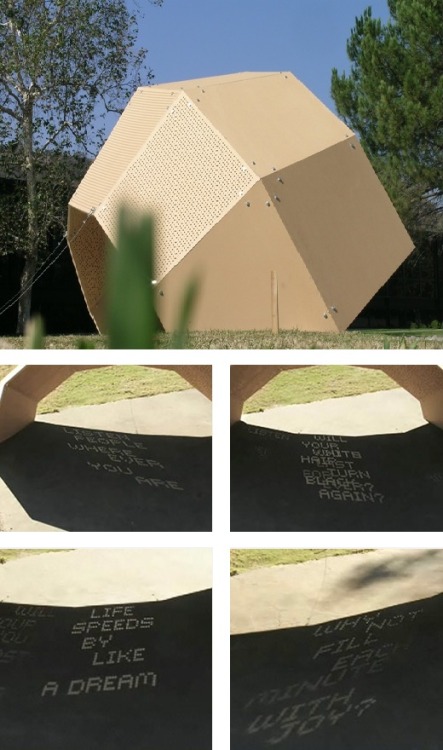
The One Day Poem Pavilion is a very cool art and poetry project. Using a complex array of perforations, light passing through the pavilion’s surface produces shifting patterns, which transform into the legible text of a poem.
The results of an extensive exploration with shadows, the One Day Poem Pavilion demonstrates the poetic, transitory, site-sensitive and time-based nature of light and shadow.
Using a complex array of perforations, the pavilion’s surface allows light to pass through creating shifting patterns, which–during specific times of the year–transform into the legible text of a poem.
The specific arrangements of the perforations reveal different shadow-poems according to the solar calendar: a theme of new-life during the summer solstice, a reflection on the passing of time at the period of the winter solstice. The time-based nature of the poem–and the visitor’s time-based encounters with it–allow viewers to have different experiences either seeing a stanza of the poem or getting the whole poem. All of these possible experiences are equally valuable and have meanings unique to the individual. This technique has the potential for producing particular effects and meanings within an architectural environment. Without the use of a source of power other than the sun, this project uses light and shadow to push the boundaries of communication and experiential delight.
How did the rose
Ever open its heart
And give to this world
All its
Beauty?
It felt the encouragement of light
Against its
Being,
Otherwise,
We all
Remain
Too
Frightened
Hafiz
Hafiz of Shiraz is a somewhat controversial figure. He was widely regarded as an infidel in his day. Today he is recognized in the East not only for the excellence of his poetry, but also as a Sufi illuminate. His major work, The Diwan, is found beside the Koran in the homes of the devout. In the West, Hafiz--a contemporary of Dante--is admired for his love-poetry; Goethe, among others, acknowledged his influence.
Natasha Trethewey is an outstanding poet/historian in the mold of Robert Penn Warren, our first Poet Laureate Consultant in Poetry. Her poems dig beneath the surface of history—personal or communal, from childhood or from a century ago—to explore the human struggles that we all face.
I started thinking about poetic odes last month and started writing notes for this prompt. I figured I would use some classics like "Ode to the West Wind" by Percy Bysshe Shelley or "Ode on a Nightingale" by John Keats. I also know there are many modern odes that address less lofty objects (like "Ode to a Dressmaker's Dummy" by Donald Justice.
But it's not that modern poets do not take on big topics for their odes. "Praise Song for the Day" by Elizabeth Alexander was her poem read at Barack Obama’s Presidential Inauguration.
You can find many sample odes online as models.
The ode form goes back to Ancient Greeks. "Ode" comes from the Greek aeidein, meaning to sing or chant. Odes were originally accompanied by music and dance, and later reserved by the Romantic poets to convey their strongest sentiments. This type of lyrical verse is classically structured in three major parts: the strophe, the antistrophe, and the epode. Originally, it was an elaborately structured poem that was written to praise or glorify an event or individual, or to describe nature intellectually as well as emotionally.
There are a number of ode forms including the Pindaric, Horatian,Irregular and English. The formal opening (strophe) is a complex metrical structure, and it is followed by an antistrophe, which mirrors the opening, and an epode, the final closing section of a different length and composed with a different metrical structure.
The William Wordsworth poem "Ode on Intimations of Immortality from Recollections of Early Childhood" is a very good example of an English language Pindaric ode. The earliest odes in the English language, using the word in its strict form, were written by Edmund Spenser.
But don't be frightened by the ode.
Laura Shovan, poets and teacher, does workshops for students in upper elementary through high school and uses odes as a prompt. Voices Fly is an anthology of student poetry (poems and prompts from the Maryland State Arts Council Artist-in-Residence program), and one chapter is her lesson on simple odes. She focuses on the use of simile, hyperbole and sensory detail and the concept of tone as it works in a simple ode. She has students read and discuss Gary Soto’s “Ode to Pablo’s Tennis Shoes.”
I like to pick up something random in the classroom. It might be a blackboard eraser, a paperclip, or a tissue. Together, the class brainstorms all of the things we can do with that object. We exaggerate -- a good time to introduce hyperbole -- in order to highlight the object’s value. With the eraser, all of our mistakes can disappear. The paperclip is like a secretary for our school work, keeping it organized and making us efficient. The tissue comforts us when we are sick, dries our tears when we are sad.
The key in an ode, as the children quickly pick up, is that we are making a persuasive argument. The words, similes and descriptions we use – the tone of the poem – needs to convince the reader that these sneakers are the best sneakers in the universe. Through tone, simple odes remind readers to stop and pay attention to everyday objects that deserve praise.
To Autumn
Season of mists and mellow fruitfulness,
Close bosom-friend of the maturing sun;
Conspiring with him how to load and bless
With fruit the vines that round the thatch-eves run;
To bend with apples the moss'd cottage-trees,
And fill all fruit with ripeness to the core;
To swell the gourd, and plump the hazel shells
With a sweet kernel; to set budding more,
And still more, later flowers for the bees,
Until they think warm days will never cease,
For summer has o'er-brimm'd their clammy cells.
Who hath not seen thee oft amid thy store?
Sometimes whoever seeks abroad may find
Thee sitting careless on a granary floor,
Thy hair soft-lifted by the winnowing wind;
Or on a half-reap'd furrow sound asleep,
Drows'd with the fume of poppies, while thy hook
Spares the next swath and all its twined flowers:
And sometimes like a gleaner thou dost keep
Steady thy laden head across a brook;
Or by a cyder-press, with patient look,
Thou watchest the last oozings hours by hours.
Where are the songs of spring? Ay, Where are they?
Think not of them, thou hast thy music too,—
While barred clouds bloom the soft-dying day,
And touch the stubble-plains with rosy hue;
Then in a wailful choir the small gnats mourn
Among the river sallows, borne aloft
Or sinking as the light wind lives or dies;
And full-grown lambs loud bleat from hilly bourn;
Hedge-crickets sing; and now with treble soft
The red-breast whistles from a garden-croft;
And gathering swallows twitter in the skies.
Ode on a Grecian Urn
Thou still unravish'd bride of quietness,Thou foster-child of silence and slow time,Sylvan historian, who canst thus expressA flowery tale more sweetly than our rhyme:What leaf-fring'd legend haunts about thy shapeOf deities or mortals, or of both,In Tempe or the dales of Arcady?What men or gods are these? What maidens loth?What mad pursuit? What struggle to escape?What pipes and timbrels? What wild ecstasy?Heard melodies are sweet, but those unheardAre sweeter; therefore, ye soft pipes, play on;Not to the sensual ear, but, more endear'd,Pipe to the spirit ditties of no tone:Fair youth, beneath the trees, thou canst not leaveThy song, nor ever can those trees be bare;Bold Lover, never, never canst thou kiss,Though winning near the goal yet, do not grieve;She cannot fade, though thou hast not thy bliss,For ever wilt thou love, and she be fair!Ah, happy, happy boughs! that cannot shedYour leaves, nor ever bid the Spring adieu;And, happy melodist, unwearied,For ever piping songs for ever new;More happy love! more happy, happy love!For ever warm and still to be enjoy'd,For ever panting, and for ever young;All breathing human passion far above,That leaves a heart high-sorrowful and cloy'd,A burning forehead, and a parching tongue.Who are these coming to the sacrifice?To what green altar, O mysterious priest,Lead'st thou that heifer lowing at the skies,And all her silken flanks with garlands drest?What little town by river or sea shore,Or mountain-built with peaceful citadel,Is emptied of this folk, this pious morn?And, little town, thy streets for evermoreWill silent be; and not a soul to tellWhy thou art desolate, can e'er return.O Attic shape! Fair attitude! with bredeOf marble men and maidens overwrought,With forest branches and the trodden weed;Thou, silent form, dost tease us out of thoughtAs doth eternity: Cold Pastoral!When old age shall this generation waste,Thou shalt remain, in midst of other woeThan ours, a friend to man, to whom thou say'st,"Beauty is truth, truth beauty,—that is allYe know on earth, and all ye need to know."
Bowie is among us. Right here
In New York City. In a baseball cap
And expensive jeans. Ducking into
A deli. Flashing all those teeth
At the doorman on his way back up.
Or he’s hailing a taxi on Lafayette
As the sky clouds over at dusk.
He’s in no rush. Doesn’t feel
The way you’d think he feels.
Doesn’t strut or gloat. Tells jokes.
I’ve lived here all these years
And never seen him. Like not knowing
A comet from a shooting star.
But I’ll bet he burns bright,
Dragging a tail of white-hot matter
The way some of us track tissue
Back from the toilet stall. He’s got
The whole world under his foot,
And we are small alongside,
Though there are occasions
When a man his size can meet
Your eyes for just a blip of time
And send a thought like SHINE
SHINE SHINE SHINE SHINE
Straight to your mind. Bowie,
I want to believe you. Want to feel
Your will like the wind before rain.
The kind everything simply obeys,
Swept up in that hypnotic dance
As if something with the power to do so
Had looked its way and said:
Go ahead.
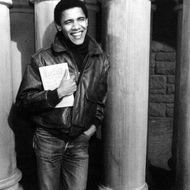
| Barack Obama at Harvard |
I haven’t read “The Waste Land” for a year, and I never did bother to check all the footnotes. But I will hazard these statements — Eliot contains the same ecstatic vision which runs from Münzer to Yeats. However, he retains a grounding in the social reality/order of his time. Facing what he perceives as a choice between ecstatic chaos and lifeless mechanistic order, he accedes to maintaining a separation of asexual purity and brutal sexual reality. And he wears a stoical face before this. Read his essay
on Tradition and the Individual Talent, as well as Four Quartets
, when he’s less concerned with depicting moribund Europe, to catch a sense of what I speak.
Remember how I said there’s a certain kind of conservatism which I respect more than bourgeois liberalism — Eliot is of this type. Of course, the dichotomy he maintains is reactionary, but it’s due to a deep fatalism, not ignorance. (Counter him with Yeats or Pound, who, arising from the same milieu, opted to support Hitler and Mussolini.) And this fatalism is born out of the relation between fertility and death, which I touched on in my last letter — life feeds on itself. A fatalism I share with the western tradition at times. You seem surprised at Eliot’s irreconcilable ambivalence; don’t you share this ambivalence yourself, Alex?
A typical manuscript for a poem might include several undated versions, with varying capitalization throughout, sometimes a "C" or an "S" that seems to be somewhere between lowercase and capital, and no degree of logic in the capitalization. While important subject words and the symbols that correspond to them are often capitalized, often (but not always) a metrically stressed word will be capitalized as well, even if it has little or no relevance in comparison to the rest of the words in the poem. Early editors removed all capitals but the first of the line, or tried to apply editorial logic to their usage. For example, poem 632 is now commonly punctuated as follows:
The Brain – is wider than the Sky –
For – put them side by side –
The one the other will contain
With ease – and You – beside –
The Brain is deeper than the sea –
For – hold them – Blue to Blue –
The one the other will absorb –
As Sponges – Buckets – do –
The Brain is just the weight of God –
For – Heft them – Pound for Pound –
And they will differ – if they do –
As Syllable from Sound –
r-p-o-p-h-e-s-s-a-g-r
whoa)s w(e loo)kupnowgath PPEGORHRASS eringint(o- aThe):l eA !p:S a (rrIvInG .gRrEaPsPhOs) torea(be)rran(com)gi(e)ngly,grasshopper;The ampersand is a curious thing in our language that dates back to the 1st century A.D.The & picked up traction in poetry with the Beats and the Black Mountain poets. (Ginsberg: "blond & naked angel") and E.E. Cummings, Frank O'Hara, Amiri Baraka, John Berryman, Nick Flynn and Nikky Finney. There was an article about its use in a recent Poets & Writers Magazine (note the & there too).
Originally, it was a ligature of the letters E and T.
What's a ligature? In writing and typography, a ligature occurs where two or more graphemes are joined as a single glyph. Ligatures usually replace consecutive characters sharing common components.
Suffice it to say, the ampersand is the most common one we use in English.
"Et" is Latin for "and" - as in et cetera, which is such a mouthful that we feel the need to shorten even that to etc. It can actually be further shortened as &c.
"I had a wonderfully happy childhood."
"All this business about artists having to have terrible childhoods doesn't play with me."
"I was desperately interested in being interesting. Poetry seemed a way of being different."
"I believe that writers write for perceived communities, and that if you are a lifelong professor of English, it's quite likely that you will write poems that your colleagues would like; that is, poems that will engage that community. I worked every day with people who didn't read poetry, who hadn't read it since they were in high school, and I wanted to write for them."
"I was so staggered I could barely respond. The next day, I backed the car out of the garage and tore the rear view mirror off the driver's side."