


Popular Posts
-
Just a note to let Poets Online (the site) users know that we are having some tech issues. In the midst of a site makeover, we started havi...
-
 In Kim Addonizio 's fourth book of poems, What Is This Thing Called Love , I was surprised to find that she had written another parade...
 -
There have been several posts online, including poet and actress Amber Tamblyn on the Poetry Foundation blog , about Diane Di Prima's re...
-
 Blake print, from Jerusalem - winged muse atop a floating sunflower, 1804-1820. I was at a workshop with Mark Doty recently and he was havin...
 -
 Philip Schultz photo by Monica Banks The Warren County Community College Visiting Authors Series continues this Wednesday, October 13th, w...
 -
The Poetry Foundation has a number of literary events and programs in celebration of National Poetry Month, April 2012. Poetry In celebr...
-
The WCCC Visiting Authors Series continues on Wednesday, March 30th, with a reading by Gerald Stern, recipient of the National Book Award fo...
-
Today is national Poem In Your Pocket Day . April 26, 2012 is the day during National Poetry Month to select a poem you love and carry it wi...
-
 Take a listen to these three poems read by Billy Collins at a Dodge Poetry Festival . Collins is much loved, and equally criticized, because...
 -
I chose this month's poem for our prompt from a collection of Stephen Dunn's poetry because I like what he is doing with that word ...
Senin, 30 April 2012
Minggu, 29 April 2012
Punctuation and Poetry
Diposting oleh triondxxx di 23.30
“Cut out all these exclamation points.
An exclamation point is like laughing at your own joke.”
—F. Scott Fitzgerald
An exclamation point is like laughing at your own joke.”
—F. Scott Fitzgerald
PUNCTUATION: Some poets use it. Some don't.
Of course, there are many poems where punctuation is most definitely necessary, but there are also cases where it is not. Are there any "rules" for its usage?
When lines are short - three words or less - punctuation (commas and periods) can look silly.
Fitzgerald may not have been a fan of the exclamation point, but the New York School of poets took a liking to it.
Walt Whitman liked... the ellipsis. Emily Dickinson was fond of using - the dash. A.R. Ammons did things with: the colon. E.E. Cummings, besides his experiments with Upper and lOWER case, liked to make use of (parentheses).
Much of this has been studied and I'm sure there are more than a few graduate theses out there on related topics.
From the Poets.org Guide to Emily Dickinson's Collected Poems (pdf download)
A typical manuscript for a poem might include several undated versions, with varying capitalization throughout, sometimes a "C" or an "S" that seems to be somewhere between lowercase and capital, and no degree of logic in the capitalization. While important subject words and the symbols that correspond to them are often capitalized, often (but not always) a metrically stressed word will be capitalized as well, even if it has little or no relevance in comparison to the rest of the words in the poem. Early editors removed all capitals but the first of the line, or tried to apply editorial logic to their usage. For example, poem 632 is now commonly punctuated as follows:
The Brain – is wider than the Sky –
For – put them side by side –
The one the other will contain
With ease – and You – beside –
The Brain is deeper than the sea –
For – hold them – Blue to Blue –
The one the other will absorb –
As Sponges – Buckets – do –
The Brain is just the weight of God –
For – Heft them – Pound for Pound –
And they will differ – if they do –
As Syllable from Sound –
E. E. Dickinson
 and E.E. Cummings may have more in common in this regard than you would expect. Cummings made his use of punctuation so much of a style that it may seem to be parody at times.
This poem about a grasshopper has just about everything happening in it.
r-p-o-p-h-e-s-s-a-g-r
   who
a)s w(e loo)kupnowgath PPEGORHRASS eringint(o- aThe):l eA !p:S a (rrIvInG .gRrEaPsPhOs) torea(be)rran(com)gi(e)ngly,grasshopper;He uses the words, punctuation, and space to create a "concrete" visual image of a grasshopper jumping. The word and letter jumble makes more sense as we dig deeper and yet some of it is for pure visual rather than reader effect.
I have used some of his poems with children who like finding the hidden poem. They find the jumping-all-about grasshopper r-p-o-p-h-e-s-s-a-g-r who as we look up now gathering to leap leaps arriving...
They realize the poem is not just meant to be "read."
And then, there's the ampersand. & Not really punctuation, but an abbreviation of a sort. As I have written on another blog:.
The ampersand is a curious thing in our language that dates back to the 1st century A.D.The & picked up traction in poetry with the Beats and the Black Mountain poets. (Ginsberg: "blond & naked angel") and E.E. Cummings, Frank O'Hara, Amiri Baraka, John Berryman, Nick Flynn and Nikky Finney. There was an article about its use in a recent Poets & Writers Magazine (note the & there too).
Originally, it was a ligature of the letters E and T.
What's a ligature? In writing and typography, a ligature occurs where two or more graphemes are joined as a single glyph. Ligatures usually replace consecutive characters sharing common components.
Suffice it to say, the ampersand is the most common one we use in English.
"Et" is Latin for "and" - as in et cetera, which is such a mouthful that we feel the need to shorten even that to etc. It can actually be further shortened as &c.
So here is our writing prompt(s) - more challenging than it might sound at first. Write a poem that deliberately makes use of punctuation to create its effect on the reader. If that seems too much the "writing exercise," try writing about punctuation.
Submission deadline: Sunday, May 27 see our submission guidelines before sending poems
Rabu, 25 April 2012
Poem in Your Pocket Day
Diposting oleh triondxxx di 21.30
You can also share your poem selection on Twitter by using the hashtag #pocketpoem.
The hope is that poems from pockets will be unfolded throughout the day with events in parks, libraries, schools, workplaces, and bookstores. Along with your library, bookstore, or shelf at home, you can find the perfect poem for your pocket by browsing the Poets.org website. You can also download pocket-sized Poem PDFs to print and share.
My poem will be in my pocket but on my phone. I have several mobile poetry archives (including the app from poets.org) so I actually have thousands of poems, as well as poet biographies and historical essays at my fingertips, anytime and anywhere.
Share a poem today!
Kooser on Writing Poetry
Diposting oleh triondxxx di 08.49
Happy birthday, Ted Kooser
! I read that today was his birthday and was pleased to read a few quotes about his approach to being a poet. "I had a wonderfully happy childhood."
"All this business about artists having to have terrible childhoods doesn't play with me."
I started writing poetry, like him, as a teenager.
"I was desperately interested in being interesting. Poetry seemed a way of being different."
"I believe that writers write for perceived communities, and that if you are a lifelong professor of English, it's quite likely that you will write poems that your colleagues would like; that is, poems that will engage that community. I worked every day with people who didn't read poetry, who hadn't read it since they were in high school, and I wanted to write for them."
He's more disciplined about writing than I am - when he was a part time poet and full time worker, he would get up at 4:30, made a pot of coffee, and write until 7, put on his suit and tie and go to work. Result? 7 books by the time he retired.
He resigned himself to being a relatively unknown poet, but he continued to write every morning. Then, in 2004, he got a phone call informing him that he had been chosen as Poet Laureate of the United States.
"I was so staggered I could barely respond. The next day, I backed the car out of the garage and tore the rear view mirror off the driver's side."
As the Poet Laureate, he started a free weekly column for newspapers called "American Life in Poetry" that is still running.
Many of his poems have appeared on The Writers Almanac site. I like this one that fits in nicely with this post.
Walking to Work
Today, it's the obsidian
ice on the sidewalk
with its milk white bubbles
popping under my shoes
that pleases me, and upon it
a lump of old snow
with a trail like a comet,
that somebody,
probably falling in love,
has kicked
all the way to the corner.
from Sure Signs: New and Selected Poems
 (University of Pittsburgh Press)
Senin, 23 April 2012
Donations to Help Diane Di Prima
Diposting oleh triondxxx di 04.00There have been several posts online, including poet and actress Amber Tamblyn on the Poetry Foundation blog, about Diane Di Prima's recent medical problems.
I'm passing on the information in the hope that some of you will join in donating for Diane's medical bills.
Earlier this month, my spirit animal and close family friend poet Michael McClure sent me an email regarding San Francisco Poet Laureate Diane Di Prima who is now 78 years old. Michael knows that Diane has had a particularly important impact on my life. Her memoir, Recollections of My Life as a Womanchanged me on a fundamental level. Her very existence, even prior to reading her memoir, shaped the way I viewed myself as an emerging woman and as a writer. Upon reading Recollections, I knew I could never go back to the way I viewed myself again. I could not NOT define myself as, above all things, a poet and a feminist, titles I had always struggled with.
Michael McClure wrote me:Diane is suffering with several painful and even life-threatening illnesses, including removal of all teeth, arthritis from her earlier back operation, extreme problems with glaucoma and a needed operation; but that’s just the top of the list. Despite all, she is in unexpectedly fine spirits. If you know of any way to help her, she would appreciate it and I would also.
 |
| via sanfranciscosentinel.com |
 and the new expanded version of Revolutionary Letters
 . Her work has been translated into over twenty languages.
Di Prima was born in Brooklyn. She attended Hunter College High School and Swarthmore College before dropping out to be a poet in Manhattan. Her official online biography notes that she is "a second generation American of Italian descent" and that "Her maternal grandfather, Domenico Mallozzi, was an active anarchist, and associate of Carlo Tresca and Emma Goldman." She began writing as a child and by the age of 19 was corresponding with Ezra Pound and Kenneth Patchen. Her first book of poetry, This Kind of Bird Flies Backward was published in 1958.


http://dianediprima.com
Minggu, 22 April 2012
Collected Poems
Diposting oleh triondxxx di 14.11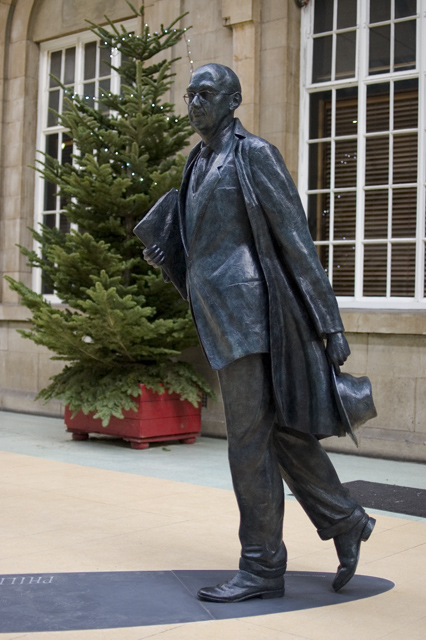 |
| Philip Larkin statue, Hull, East Riding of Yorkshire, England. The statue, by sculptor Martin Jennings, was unveiled on the Hull Paragon Station concourse on 2 December 2010, 25 years to the day after the poet Philip Larkin died. |
A book review I read this weekend got me thinking about all of our "collected poems." By that I mean our "total" output of poems. I have been writing with some degree of seriousness for three decades. There are hundreds of poems. But when I started the editing process for my first book, I had trouble selecting the 70 I wanted to use.
It's not that there were only 70 good poems. There were many more I wanted included, but there were also many early ones that I did not even consider.
Philip Larkin’s The Complete Poems
 is 730 pages. Only 90 of those pages are poems that Larkin saw fit to collect in his lifetime.
 Paul Muldoon
, reviewing the volume in The New York Times, said:Hardly worth even a first look are any of the page after page of “poems not published in the poet’s lifetime.” These include such drolleries as the couplet “Walt Whitman / Was certainly no titman.” Isn’t it worth asking why these poems were unpublished in the poet’s lifetime? Might it be that they were, and are, a “load of crap”? Like Bishop, Larkin is not particularly well served by having every napkin- or matchbook-jotting published. Almost none of these matchbook-jottings illuminate the essential core of Larkin’s work in the way that “Inventions of the March Hare,” say, casts significant light on early Eliot. In the end, though, such is the strength and solidity of that essential core that Larkin’s reputation as the archetypical English poet of the second half of the 20th century should persist well into the 21st.
That's rough. But maybe Philip Larkin
would agree.I write many of my poems longhand first in bound blank books. I have, for example, one book with about a hundred short poems (haiku and other short forms and short free verse). I don't know that I would ever publish more than a handful of them, and I'm sure that I wouldn't be thrilled to have the entire collection published.
Some writers are known for having destroyed their own writing to protect their reputation. Others leave it all to some institution to archive and perhaps hope that some of it will find an audience when they are gone (and don't have to read the reviews).
What do you do with your collected poems?
What do you want to happen to them when you are gone?
Home is so Sad
by Philip Larkin
Home is so sad. It stays as it was left,
Shaped to the comfort of the last to go
As if to win them back. Instead, bereft
Of anyone to please, it withers so,
Having no heart to put aside the theft
And turn again to what it started as,
A joyous shot at how things ought to be,
Long fallen wide. You can see how it was:
Look at the pictures and the cutlery.
The music in the piano stool. That vase.
Sabtu, 07 April 2012
Poetry Heals
Diposting oleh triondxxx di 12.43Poetry Heals is a program for New Jersey hospitals and healthcare workers across New Jersey to celebrate National Poetry Month in cooperation with the New Jersey Council for the Humanities and CavanKerry Press.
Poetry has been shown to be an important tool for healing—both for patients and for caregivers. This new program will support the efforts of hospitals statewide to include poetry in their healing practice and to create new opportunities for healthcare workers and others to experience the power of poetry.
Poetry Heals Workshops will be lead by poets from CavanKerry Press. These workshops will give healthcare workers the chance to create their own poetry as a means of healing themselves and to consider how poetry can be a way to understand the experiences of others. These workshops will take place at Cooper University Hospital, Camden; Morristown Medical Center, Morristown; Newton Medical Center, Newton; Overlook Hospital, Summit; and, UMDNJ, Newark.
These events are being offered as part of Literature and Medicine: Humanities at the Heart of Health Care ® a national award-winning reading and discussion program for health care professionals that, as one participant writes, “renews the heart and soul of health care.” Discussions have helped health care professionals across the country improve their communication and interpersonal skills while increasing their cultural awareness, empathy for patients, and job satisfaction.
Afterwards, you feel a loss
like an amputee the morning after the operation
or a newly declawed cat discovering with horror
it can no longer climb trees.
The loss is not all bad. You know, of course,
that you are whole, you try to count
your blessings on your body: ten fingers,
two eyes, also two legs
and a functioning set of organ systems.
As if this should console you!
You preoccupy yourself with it, trying
to restore what is gone...
from "Manic Depressive" - We Mad Climb Shaky Ladders
 by Pamela Spiro Wagner
Minggu, 01 April 2012
Poetry Foundation Celebrates National Poetry Month
Diposting oleh triondxxx di 12.00The Poetry Foundation has a number of literary events and programs in celebration of National Poetry Month, April 2012.
Poetry
In celebration of the magazine’s centennial year and National Poetry Month, more than 60,000 free copies of Poetry’s April issue were distributed to more than 11,000 reading groups around the world—triple the number of participants in 2011. In the April 2012 issue, Poetry readers find new poetry from Karen An-Hwei Lee, Yusef Komunyakaa, David Lehman, Sandra Simonds, Wendy Videlock, and others, as well as poems from the magazine’s 100-year archive, including original work from Gwendolyn Brooks, Geoffrey Hill, Howard Nemerov, and Muriel Rukeyser. Readers can find the entire April issue of Poetry online as of April 1, along with the April discussion guide and the April magazine podcast.
In celebration of the magazine’s centennial year and National Poetry Month, more than 60,000 free copies of Poetry’s April issue were distributed to more than 11,000 reading groups around the world—triple the number of participants in 2011. In the April 2012 issue, Poetry readers find new poetry from Karen An-Hwei Lee, Yusef Komunyakaa, David Lehman, Sandra Simonds, Wendy Videlock, and others, as well as poems from the magazine’s 100-year archive, including original work from Gwendolyn Brooks, Geoffrey Hill, Howard Nemerov, and Muriel Rukeyser. Readers can find the entire April issue of Poetry online as of April 1, along with the April discussion guide and the April magazine podcast.
Harriet: The Blog
The Poetry Foundation’s blog, Harriet, will host more than 30 poets during the month of April, including Stephen Burt, Olena Kalytiak Davis, Daisy Fried, D.A. Powell, and Rachel Zucker. Poets will engage in a lively month-long conversation about poetry, poetics, and the poetry blogosphere. This is the third year the blog will host a National Poetry Month discussion. Follow the conversation.
The Poetry Foundation’s blog, Harriet, will host more than 30 poets during the month of April, including Stephen Burt, Olena Kalytiak Davis, Daisy Fried, D.A. Powell, and Rachel Zucker. Poets will engage in a lively month-long conversation about poetry, poetics, and the poetry blogosphere. This is the third year the blog will host a National Poetry Month discussion. Follow the conversation.
The East Village Poetry Walk
Passing Stranger—The East Village Poetry Walk is the new audio walking tour of poetry-related sites in New York City’s East Village. Focusing on poetry and poets from the 1950s to the present, including Allen Ginsberg, Kenneth Koch, Frank O’Hara, Ron Padgett, and Anne Waldman, the tour stops include St. Mark’s Church in-the-Bowery, W.H. Auden’s old apartment building, Tompkins Square Park, and the Bowery Poetry Club. Each stop presents a montage of poetry, interviews, and archival recordings relating to that particular place. Users can take the two-mile tour using an mp3 player. Download the free audio file and a map outlining the route. Passing Stranger—The East Village Poetry Walk was created by Pejk Malinovski with support from the Poetry Foundation.
Passing Stranger—The East Village Poetry Walk is the new audio walking tour of poetry-related sites in New York City’s East Village. Focusing on poetry and poets from the 1950s to the present, including Allen Ginsberg, Kenneth Koch, Frank O’Hara, Ron Padgett, and Anne Waldman, the tour stops include St. Mark’s Church in-the-Bowery, W.H. Auden’s old apartment building, Tompkins Square Park, and the Bowery Poetry Club. Each stop presents a montage of poetry, interviews, and archival recordings relating to that particular place. Users can take the two-mile tour using an mp3 player. Download the free audio file and a map outlining the route. Passing Stranger—The East Village Poetry Walk was created by Pejk Malinovski with support from the Poetry Foundation.
Poetry for Children: Martha Speaks and Arthur
The Poetry Foundation has teamed up with WGBH to help promote poetry to children during National Poetry Month. Best-selling poet Billy Collins and inaugural Children’s Poet Laureate Jack Prelutsky will appear on episodes of beloved children’s TV programs Martha Speaks and Arthur on Monday, April 2, on PBS KIDS (check local listings). Beyond the broadcast, kids are invited to create and publish their own poetry online with the all-new game Martha’s Rhyme Time at pbskids.org/martha. Kids can also write and share their poems online with Fern’s Poetry Club at pbskids.org/arthur. In addition, the Poetry Foundation’s @PoetryFound Twitter handle will participate in a Tweet-Up discussion of children’s poetry on Wednesday, March 28, from 8pm to 9pm CT.
The Poetry Foundation has teamed up with WGBH to help promote poetry to children during National Poetry Month. Best-selling poet Billy Collins and inaugural Children’s Poet Laureate Jack Prelutsky will appear on episodes of beloved children’s TV programs Martha Speaks and Arthur on Monday, April 2, on PBS KIDS (check local listings). Beyond the broadcast, kids are invited to create and publish their own poetry online with the all-new game Martha’s Rhyme Time at pbskids.org/martha. Kids can also write and share their poems online with Fern’s Poetry Club at pbskids.org/arthur. In addition, the Poetry Foundation’s @PoetryFound Twitter handle will participate in a Tweet-Up discussion of children’s poetry on Wednesday, March 28, from 8pm to 9pm CT.
The POETRY App
The National Magazine Award-nominated POETRY app is now available for iPhone, iPad, and Android. The app features Poetry magazine poems, plus hundreds of additional poems by classic and contemporary poets—from William Shakespeare to César Vallejo to Heather McHugh. Users can search for old favorites with memorable lines, discover new poems to fit any mood, save favorite poems to read and share later through Facebook, Twitter, or e-mail. Download the free app.
The National Magazine Award-nominated POETRY app is now available for iPhone, iPad, and Android. The app features Poetry magazine poems, plus hundreds of additional poems by classic and contemporary poets—from William Shakespeare to César Vallejo to Heather McHugh. Users can search for old favorites with memorable lines, discover new poems to fit any mood, save favorite poems to read and share later through Facebook, Twitter, or e-mail. Download the free app.
American Life in Poetry
April 2012 marks the seventh anniversary of American Life in Poetry, a project that brings free poetry content to newspapers around the country. Founded by former U.S. Poet Laureate Ted Kooser, American Life in Poetry regularly runs in newspapers across the country and is published in a range of Internet outlets. Over the last seven years the column has featured more than 300 poets, including award-winning poets Linda Pastan, Jane Hirshfield, and Robert Bly. The column not only brings contemporary poetry to a wider audience but also restores poetry’s traditional place in newspapers, where the column is well received by regular readers. Sign up to receive the column.
April 2012 marks the seventh anniversary of American Life in Poetry, a project that brings free poetry content to newspapers around the country. Founded by former U.S. Poet Laureate Ted Kooser, American Life in Poetry regularly runs in newspapers across the country and is published in a range of Internet outlets. Over the last seven years the column has featured more than 300 poets, including award-winning poets Linda Pastan, Jane Hirshfield, and Robert Bly. The column not only brings contemporary poetry to a wider audience but also restores poetry’s traditional place in newspapers, where the column is well received by regular readers. Sign up to receive the column.
Follow the Poetry Foundation and Poetry on Facebook
at www.facebook.com/
or on Twitter @PoetryFound
at www.facebook.com/
or on Twitter @PoetryFound
Subscribe to:
Postingan (Atom)
Template by:
